THE RESEARCH
What the research shows about sublingual immunotherapy for food allergy
About twenty years of studies
Mostly peanut
Not FDA-approved
Reviewed by Hunter Smith, MD · Last reviewed October 2026

IN SHORT
Sublingual immunotherapy is often called SLIT. It means putting a small, measured amount of a food protein under the tongue every day.
Studies going back about twenty years show it can raise how much of a food a person with a food allergy can be exposed to before they react.
For most people it does not make the food allergy go away. Most people keep avoiding the food. What changes is how much of an accidental exposure it takes to cause a reaction.
Side effects are usually mild. The most common one is itching in the mouth or throat.
Most of the research is on peanut. There is much less on milk, egg, hazelnut and peach, and almost none on other foods.
SLIT is not approved by the FDA for food allergy. Allergists who offer it are prescribing it off-label.
It works less well than oral immunotherapy (OIT) at building up tolerance to a full serving. It causes fewer whole-body reactions.
Words you will see in these studies
Food allergy studies measure a few specific things. Knowing what they mean makes the studies easier to read.
Desensitized
you can be exposed to more of the food without reacting, as long as you keep taking the daily dose. The protection depends on staying on treatment.
Remission
protection that lasts after treatment stops. It is tested by pausing the dose for a set time and then doing a supervised challenge.
Oral food challenge
a supervised test in a clinic where you eat increasing amounts of the food while a medical team stands by. This is how studies measure whether treatment worked.
Milligrams (mg) of protein
doses are measured in milligrams (mg) of the food's protein, not in grams (weight) of food. One average peanut contains roughly 250 mg of peanut protein, so 750 mg is about three peanuts.
Intention-to-treat vs Per-Protocol
some study results count everyone who started the study whether they finished the study or not. This is called intention-to-treat. Other results only count the people who followed the study protocol without major deviations. This is called per-protocol. Both are given when studies report both.
HOW BIG IS A MILLIGRAM DOSE?
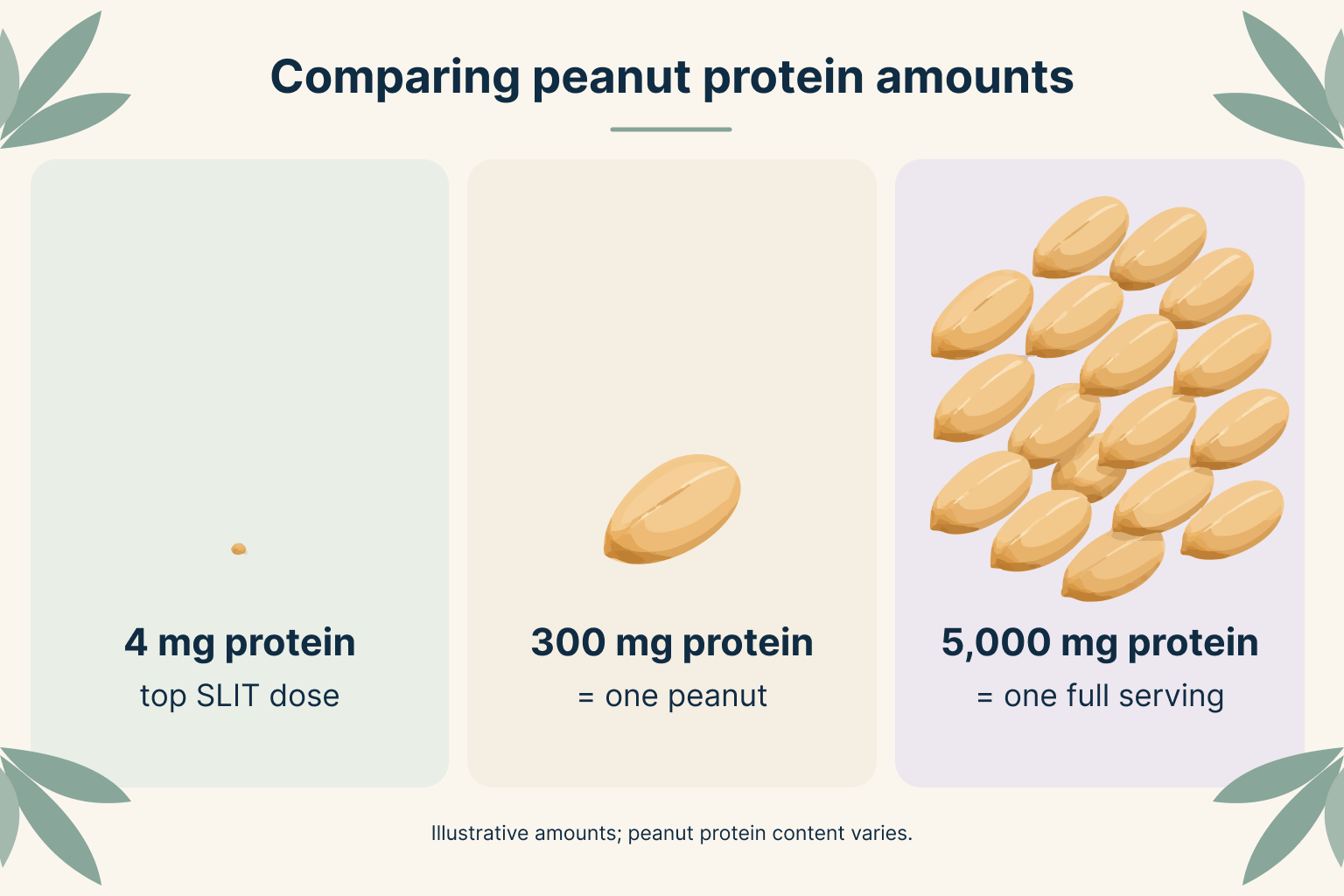
What SLIT can do, depending on what you want from it
People choose SLIT to treat food allergy with different goals. The evidence is stronger for some goals than others. It is worth being clear about your goals before you start.
GOAL 1
Protection against an accidental exposure
67 in 100
This is what SLIT does best, and it is what most of the research measures. In the longest study, 67 out of 100 children could eat at least 750 mg of peanut protein (about three peanuts) after three to five years of daily dosing. That is not enough to eat peanut freely. It is usually enough that a bite of the wrong cookie is no longer an emergency.
GOAL 2
A gentler way to start treatment, or something to do while you wait
35 of 50
Some people use SLIT as a first step before oral immunotherapy. In one study of 188 patients, a small group went on to a low-dose challenge, and 35 of 50 of those challenged passed cleanly enough to start OIT at a 300 mg dose without the usual slow build-up. Note: That study followed patients up to the point of starting OIT. It did not report how they did afterward.
The wait lists for OIT can be long, buildup can take many in-clinic appointments, and a number of studies show that the younger a person begins treatment, the better their outcomes. SLIT may be something you can begin now because the observed visits are much shorter and the risk of severe reactions is very low.
GOAL 3
Lasting protection in very young children
48 in 100
In a randomized, placebo-controlled trial of 50 children aged 1 to 4, 48 out of 100 were still protected three months after stopping treatment, a state doctors call remission. None of the children on placebo reached remission. Results were best in the youngest children, aged one and two.
Three months is as long as anyone has tested, so nobody knows whether this protection lasts for years. A separate study that followed older children after stopping found that about half had lost their protection by around 22 weeks (about 6 months). Desensitization, and even remission, is not the same thing as a cure.
The studies on SLIT for food allergy
A plain-language summary of what each study found. The exact figures and journal citations are in the full data table further down.
Kim 2024
50 people
Peanut, ages 1–4
60 in 100 could eat about 4,400 mg of peanut protein after 3 years of SLIT, compared with none of the children on placebo. 48 in 100 were still protected 3 months after stopping.
What to know: Randomized and placebo-controlled. No child in either group needed epinephrine.
Kim 2023
54 people
Peanut, ages 1–11
About 70 in 100 who completed treatment could eat at least 800 mg. 36 in 100 passed a 5,000 mg challenge.
What to know: Open-label, no control group. Protection faded after stopping: half had lost it by about 22 weeks.
Kim 2019
48 people
Peanut, ages 1–11
67 in 100 could eat at least 750 mg — about 3 peanuts. 25 in 100 passed a 5,000 mg challenge.
What to know: 3 to 5 years of daily dosing. Just under a quarter of families stopped before the end.
Fleischer 2013
40 people
Peanut, ages 12–37
The average person who responded could eat about 496 mg — roughly 2 peanuts. No one could eat a full 5,000 mg serving.
What to know: The authors describe the effect as modest. One person had a reaction at home that needed epinephrine.
Narisety 2015
21 people
Peanut, ages 7–13
SLIT and OIT both raised thresholds, but OIT raised them far more — about 22× versus 141×.
What to know: 9% of SLIT doses caused any reaction, compared with 43% of OIT doses. No one on SLIT needed epinephrine.
Keet 2012
30 people
Milk, ages 6–17
1 of 10 who stayed on SLIT passed a full 8 g milk challenge, compared with 14 of 20 who moved on to OIT.
What to know: OIT caused about 11× more whole-body reactions. Two children needed epinephrine after breathing in the liquid.
Soller 2024
188 people
Several foods, ages 4–18
Among a small group who reached a test challenge, 35 of 50 passed the challenge and transitioned into a low OIT dose.
What to know: Over 19,000 doses, only one serious reaction during buildup. None during maintenance.
Williams 2025
305 people
Several foods
40 of 57 test challenges passed into a low OIT dose.
What to know: About 2 in 100 had a moderate reaction during buildup. No severe reactions.
Safety of SLIT
Safety is one of the biggest concerns about immunotherapy. This is what the research does and does not show.

45 of 48
children had mild symptoms at some point, on about 5 in 100 doses (Kim 2019)
0
epinephrine for a home dose, across 75,366 doses (Kim 2019)
80 vs 28
in 100 children had mouth itching, on treatment versus placebo (Kim 2024)
Most reactions to SLIT for food allergy are mild and are limited to itching or tingling in the mouth and throat. Mouth itch is quite common. In one long study, 45 of 48 children had mild symptoms at some point, on about 5 in 100 doses.
Kim 2019
Across 75,366 doses taken at home in that study, no one needed epinephrine for a home dose.
Kim 2019
In the randomized trial of 1 to 4 year olds, no child needed epinephrine in either the treatment group or the placebo group. Mouth itching was more common with treatment — about 80 in 100 children compared with 28 in 100 on placebo.
Kim 2024
Compared with OIT, SLIT causes far fewer whole-body reactions. In a head-to-head milk study, whole-body reactions were about 11 times more common with OIT. But the total number of reactions of any kind was about the same between OIT and SLIT.
Keet 2012
Eosinophilic esophagitis, a condition that causes trouble swallowing, has been reported with oral immunotherapy in about 3% of patients. SLIT is a recognized risk that should be discussed and watched for.
FULL DATA
The studies, with the numbers in full
The same eight studies as the summary above, with the clinical detail and citations.
Kim 2024
Peanut, ages 1–4. Randomized, placebo-controlled.
N = 50
DOSE AND DURATION
3 years of SLIT. [Maintenance dose to be added]
EFFICACY (WITH QUALIFIERS)
About 4,400 mg of peanut protein tolerated after 3 years in 60 in 100 children, compared with none on placebo. 48 in 100 in remission 3 months after stopping; none on placebo reached remission. Results were best in children aged 1 and 2. Remission tested at 3 months only. [Exact counts and confidence intervals to be added]
SAFETY
No child in either group needed epinephrine. Mouth itching in about 80 in 100 children on treatment compared with 28 in 100 on placebo.
CITATION
[Journal citation and DOI or PubMed ID to be added]
Kim 2023
Peanut, ages 1–11. Open-label, no control group.
N = 54
DOSE AND DURATION
[Dose and duration to be added]
EFFICACY (WITH QUALIFIERS)
About 70 in 100 who completed treatment could eat at least 800 mg. 36 in 100 passed a 5,000 mg challenge. Protection faded after stopping: half had lost it by about 22 weeks (about 6 months). [Exact counts and confidence intervals to be added]
SAFETY
[Safety data to be added]
CITATION
[Journal citation and DOI or PubMed ID to be added]
Kim 2019
Peanut, ages 1–11.
N = 48
DOSE AND DURATION
3 to 5 years of daily dosing. [Maintenance dose to be added]
EFFICACY (WITH QUALIFIERS)
67 in 100 could eat at least 750 mg (about 3 peanuts). 25 in 100 passed a 5,000 mg challenge. Just under a quarter of families stopped before the end. [Exact counts and confidence intervals to be added]
SAFETY
45 of 48 children had mild symptoms at some point, on about 5 in 100 doses. No epinephrine needed for any of 75,366 home doses.
CITATION
[Journal citation and DOI or PubMed ID to be added]
Fleischer 2013
Peanut, ages 12–37.
N = 40
DOSE AND DURATION
[Dose and duration to be added]
EFFICACY (WITH QUALIFIERS)
Among those who responded, the average threshold was about 496 mg (roughly 2 peanuts). No one could eat a full 5,000 mg serving. The authors describe the effect as modest. [Exact counts to be added]
SAFETY
One person had a reaction at home that needed epinephrine.
CITATION
[Journal citation and DOI or PubMed ID to be added]
Narisety 2015
Peanut, ages 7–13. SLIT compared with OIT.
N = 21
DOSE AND DURATION
[Dose and duration to be added]
EFFICACY (WITH QUALIFIERS)
SLIT and OIT both raised thresholds; OIT raised them far more — about 22× (SLIT) versus 141× (OIT).
SAFETY
9% of SLIT doses caused any reaction, compared with 43% of OIT doses. No one on SLIT needed epinephrine.
CITATION
[Journal citation and DOI or PubMed ID to be added]
Keet 2012
Milk, ages 6–17. SLIT compared with OIT.
N = 30
DOSE AND DURATION
[Dose and duration to be added]
EFFICACY (WITH QUALIFIERS)
1 of 10 who stayed on SLIT passed a full 8 g milk challenge, compared with 14 of 20 who moved on to OIT.
SAFETY
Whole-body reactions were about 11× more common with OIT. Total reactions of any kind were about the same between OIT and SLIT. Two children needed epinephrine after breathing in the liquid.
CITATION
[Journal citation and DOI or PubMed ID to be added]
Soller 2024
Several foods, ages 4–18. SLIT as a step before OIT.
N = 188
DOSE AND DURATION
Over 19,000 doses. [Regimen to be added]
EFFICACY (WITH QUALIFIERS)
Among a small group who reached a test challenge, 35 of 50 passed the challenge and transitioned into a low OIT dose (300 mg) without the usual slow build-up. Patients were followed only up to the point of starting OIT; later outcomes were not reported.
SAFETY
Only one serious reaction during buildup. None during maintenance.
CITATION
[Journal citation and DOI or PubMed ID to be added]
Williams 2025
Several foods.
N = 305
DOSE AND DURATION
[Dose and duration to be added]
EFFICACY (WITH QUALIFIERS)
40 of 57 test challenges passed into a low OIT dose.
SAFETY
About 2 in 100 had a moderate reaction during buildup. No severe reactions.
CITATION
[Journal citation and DOI or PubMed ID to be added]
What the evidence does not show
SLIT builds less tolerance than OIT.
Every study that compares SLIT with OIT has the same finding. If your goal is eating a full serving of the food, OIT is more likely to get you there.
Almost all the evidence is about peanut.
Milk and egg have essentially no published SLIT trials. The hazelnut evidence rests on 23 adults. Talk to your allergist about their internal data on SLIT for other foods.
Nobody knows how long protection lasts after stopping.
The longest period studied was three months.
SLIT is not FDA approved for food allergy.
There is no approved food SLIT product in the United States. Insurance coverage is inconsistent as a result.
There are limited studies of SLIT for food allergy for adults.
Almost all of the studies were done in children.
In adults, the pooled effect is null.
[Detail and citation to be added]
Real-world cohorts are uncontrolled.
[Detail and citation to be added]
Trial populations excluded the highest-risk patients.
[Detail and citation to be added]
KEEP READING