INVESTIGATIONAL · NOT YET FDA-APPROVED
The peanut patch (Viaskin): what it is and where it stands
Not approved, and not available yet
Worn on the skin, no peanut eaten
Raises tolerance to about one to four peanuts
Reviewed by Hunter Smith, MD · Last reviewed October 2026

IN SHORT
The peanut patch is not approved and you cannot get it yet.
Viaskin Peanut is a patch worn on the skin that delivers a small amount of peanut protein without eating peanut. It is made by DBV Technologies.
Two large trials have now finished. In toddlers aged 1 to 3, 67% of children on the patch met the study’s success threshold after a year, against 33% on a placebo patch. In children aged 4 to 7, it was 47% against 15%.
The company filed for FDA approval in late 2026 for the 4 to 7 age group.
The patch raises the amount of peanut a child can tolerate before reacting — roughly one to four peanuts depending on how sensitive they were to begin with, not a full serving. It is protection against an accidental exposure, not ability to eat peanut freely. Children still avoid peanut and keep their epinephrine.
How it works
Worn on the skin, replaced every day.
Peanut protein is held against the skin, where immune cells sit close to the surface, and the immune system is exposed to it there rather than through the stomach or an injection.
Patients do not eat the food.
While the patch is still a form of immunotherapy, the practical difference from oral immunotherapy is that you do not have to measure and swallow the food every day.
Serious side effects are lower.
Because only small amounts of peanut protein reach the bloodstream and the peanut protein never enters the digestive system in any quantity, whole-body reactions are far less common than in OIT. Most side effects are mild skin reactions where the patch sits. The majority of patients get these mild skin reactions, especially early on, and they tend to fade over time.
The patch builds less tolerance.
Oral immunotherapy can get people to a full serving. The patch raises the reacting threshold to somewhere around one to four peanuts in the children it helps.
What the trials found
DBV has completed two main phase 3 trials, one in toddlers and one in older children. Both compared the patch against a placebo patch for 12 months.
Topic
EPITOPE — TODDLERS
VITESSE — CHILDREN
WHAT THAT MEANS
Ages
1 to 3 years
4 to 7 years
Two separate age groups, tested separately.
Children in the trial
362 in the main part
654
Both large. VITESSE is the largest food immunotherapy trial ever run.
Length
12 months
12 months
One year of daily patches.
Met the success threshold vs. placebo
67.0% vs 33.5%
46.6% vs. 14.8%
Two out of three toddlers, and about one in two older children met the success threshold.
Serious side effects
Low rates reported
No treatment-related serious adverse events
Mostly skin reactions where the patch sits.
Treatment-related anaphylaxis
Low rates reported
0.5% — 2 children, both continued
Rare, and far below what oral immunotherapy produces.
Stopped because of side effects
Low rates reported
3.2%, against 0.5% on the placebo patch
Most children stayed on treatment.
Ages
EPITOPE — TODDLERS
1 to 3 years
VITESSE — CHILDREN
4 to 7 years
WHAT THAT MEANS
Two separate age groups, tested separately.
Children in the trial
EPITOPE — TODDLERS
362 in the main part
VITESSE — CHILDREN
654
WHAT THAT MEANS
Both large. VITESSE is the largest food immunotherapy trial ever run.
Length
EPITOPE — TODDLERS
12 months
VITESSE — CHILDREN
12 months
WHAT THAT MEANS
One year of daily patches.
Met the success threshold vs. placebo
EPITOPE — TODDLERS
67.0% vs 33.5%
VITESSE — CHILDREN
46.6% vs. 14.8%
WHAT THAT MEANS
Two out of three toddlers, and about one in two older children met the success threshold.
Serious side effects
EPITOPE — TODDLERS
Low rates reported
VITESSE — CHILDREN
No treatment-related serious adverse events
WHAT THAT MEANS
Mostly skin reactions where the patch sits.
Treatment-related anaphylaxis
EPITOPE — TODDLERS
Low rates reported
VITESSE — CHILDREN
0.5% — 2 children, both continued
WHAT THAT MEANS
Rare, and far below what oral immunotherapy produces.
Stopped because of side effects
EPITOPE — TODDLERS
Low rates reported
VITESSE — CHILDREN
3.2%, against 0.5% on the placebo patch
WHAT THAT MEANS
Most children stayed on treatment.
What “met the success threshold” means
The measure
The effect of the patch was measured by comparing the amount of peanut a child could tolerate without reaction before treatment vs. after 12 months of treatment. Success meant reaching a set target without reacting but did not mean the child could eat peanut normally.
The target
The target success threshold was higher for children who were less sensitive to begin the trials. Even the highest target was only a few peanuts.
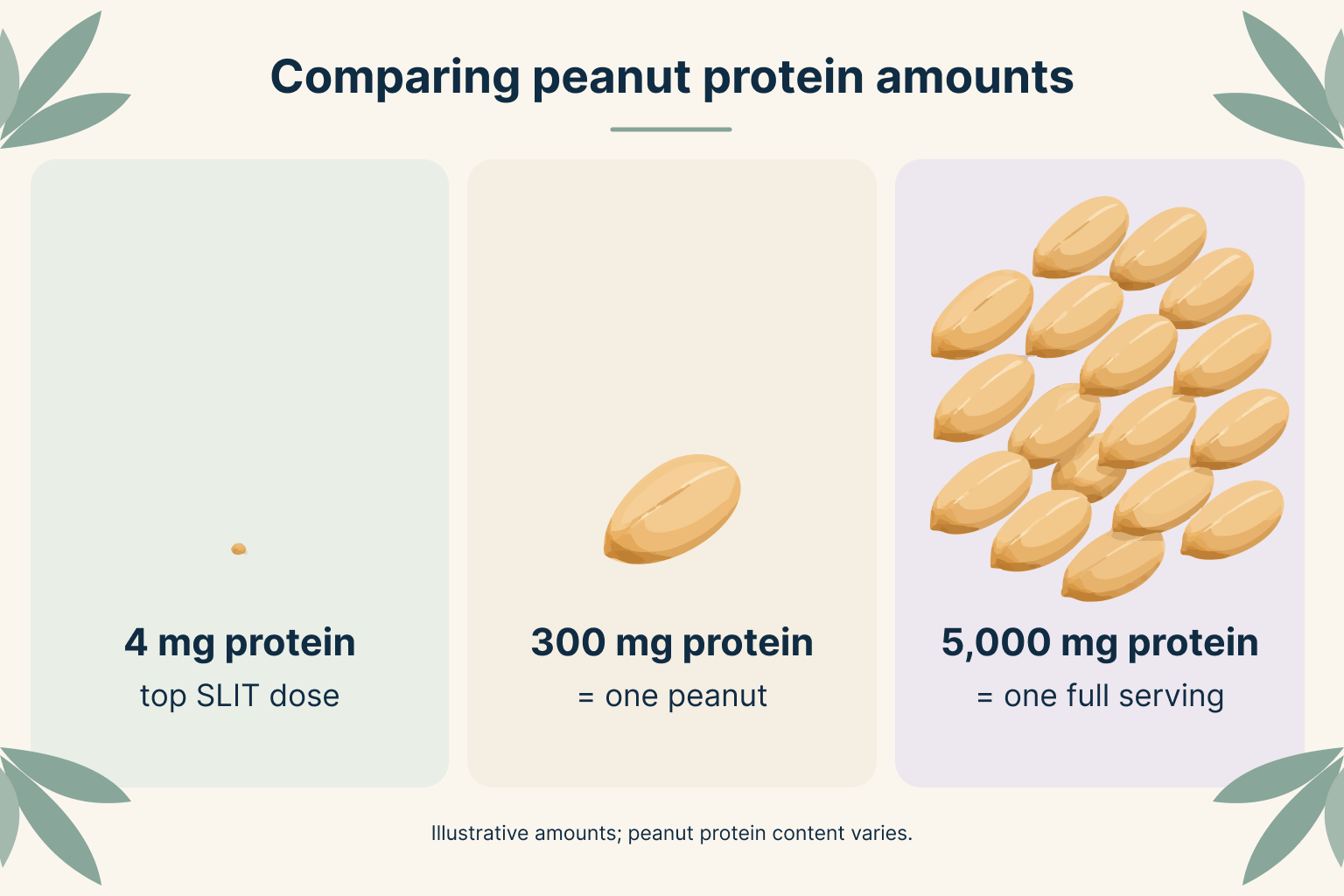
Success was not to eat a normal serving. A full serving in a food challenge is about 5,000 mg. The patch is a treatment aimed at making an accidental bite okay, not at eating peanut back on the menu.
HOW BIG IS A MILLIGRAM DOSE?
Why the toddler result is harder to read than it looks
In the toddler trial, a third of the children on the placebo patch also met the threshold. That is high for a placebo group, but some young children outgrow peanut allergy on their own, and a year is long enough for that to happen. The same effect is much smaller in the 4 to 7 group, where only 15% of the placebo-patch children improved. Older children are less likely to outgrow the allergy naturally. In both studies, the real patch roughly doubled or tripled a child’s chance of reaching the goal, an increase of about 30 percentage points compared to the placebo patch, which is still a significant benefit.
Where FDA review stands
It is not approved yet.
As of September 2026 the patch has been submitted to the FDA and is awaiting review, for the 4 to 7 age group first.
Approval for one age group does not cover others.
If the 4 to 7 filing succeeds, the toddler group would be a separate decision.
How it compares with the other options
Topic
PEANUT PATCH
ORAL IMMUNOTHERAPY
SUBLINGUAL IMMUNOTHERAPY
Available now
No
Yes, off-label
Yes, off-label
How it is given
A patch on the skin, changed daily
A measured amount of the food, eaten daily
A liquid held under the tongue daily
Do you eat the food
No
Yes
Yes, protein is still swallowed
Protection built
Around one to four peanuts in children who respond
Many patients achieve a full serving
A few hundred to a few thousand milligrams
Main side effects
Skin reactions where the patch sits
Whole-body reactions, stomach upset
Mouth itching
Daily restrictions
None described in the trials
Rest period, no exercise or hot showers around dosing
Few
Available now
PEANUT PATCH
No
ORAL IMMUNOTHERAPY
Yes, off-label
SUBLINGUAL IMMUNOTHERAPY
Yes, off-label
How it is given
PEANUT PATCH
A patch on the skin, changed daily
ORAL IMMUNOTHERAPY
A measured amount of the food, eaten daily
SUBLINGUAL IMMUNOTHERAPY
A liquid held under the tongue daily
Do you eat the food
PEANUT PATCH
No
ORAL IMMUNOTHERAPY
Yes
SUBLINGUAL IMMUNOTHERAPY
Yes, protein is still swallowed
Protection built
PEANUT PATCH
Around one to four peanuts in children who respond
ORAL IMMUNOTHERAPY
Many patients achieve a full serving
SUBLINGUAL IMMUNOTHERAPY
A few hundred to a few thousand milligrams
Main side effects
PEANUT PATCH
Skin reactions where the patch sits
ORAL IMMUNOTHERAPY
Whole-body reactions, stomach upset
SUBLINGUAL IMMUNOTHERAPY
Mouth itching
Daily restrictions
PEANUT PATCH
None described in the trials
ORAL IMMUNOTHERAPY
Rest period, no exercise or hot showers around dosing
SUBLINGUAL IMMUNOTHERAPY
Few
What is not known
We do not know much about what happens after treatment stops.
The trials mostly measured children while they were still wearing the patch, and only a few children have been tested after stopping.
The peanut patch is the only one studied in large trials.
Patches for other foods, like milk, have been tested in smaller studies but are not close to being available.
There is no head-to-head comparison against oral or sublingual immunotherapy.
Nothing is known about using it alongside another treatment.
What to do now
If your child is very young
The best chance for lasting benefit from any food allergy treatment seems to be in the youngest children and the chance may fade as the child gets older. It is worth asking an allergist about what can be done now.
If you have a slightly older child
The patch may become available in 2027. Talk to your allergist and let them know about your interest.
Questions to ask your allergist
Given my child’s age, is it worth waiting to see whether the patch is approved?
How does the protection the patch builds compare with what you would expect from treatments you already offer?
KEEP READING