TREATMENT GUIDE
Palforzia has been discontinued. Peanut oral immunotherapy is still available.
Production stopped 31 July 2026
A business decision, not safety
Oral immunotherapy is still available
Reviewed by Hunter Smith, MD · Last reviewed October 2026

IN SHORT
Palforzia was discontinued, but oral immunotherapy is widely available.
Palforzia was a measured peanut powder approved by the FDA for use in oral immunotherapy. Its manufacturer stopped production on 31 July 2026 for business reasons, not because of safety or effectiveness.
Allergists have treated peanut allergy with oral immunotherapy for years using their own measured peanut products, and continue to offer this treatment.
What happened
What Palforzia was
Palforzia was a measured peanut powder taken every day to build up tolerance to peanut. It started patients at 3 mg of peanut protein, about one hundredth of a peanut, and increased in steps to 300 mg, roughly one peanut.
31 July 2026
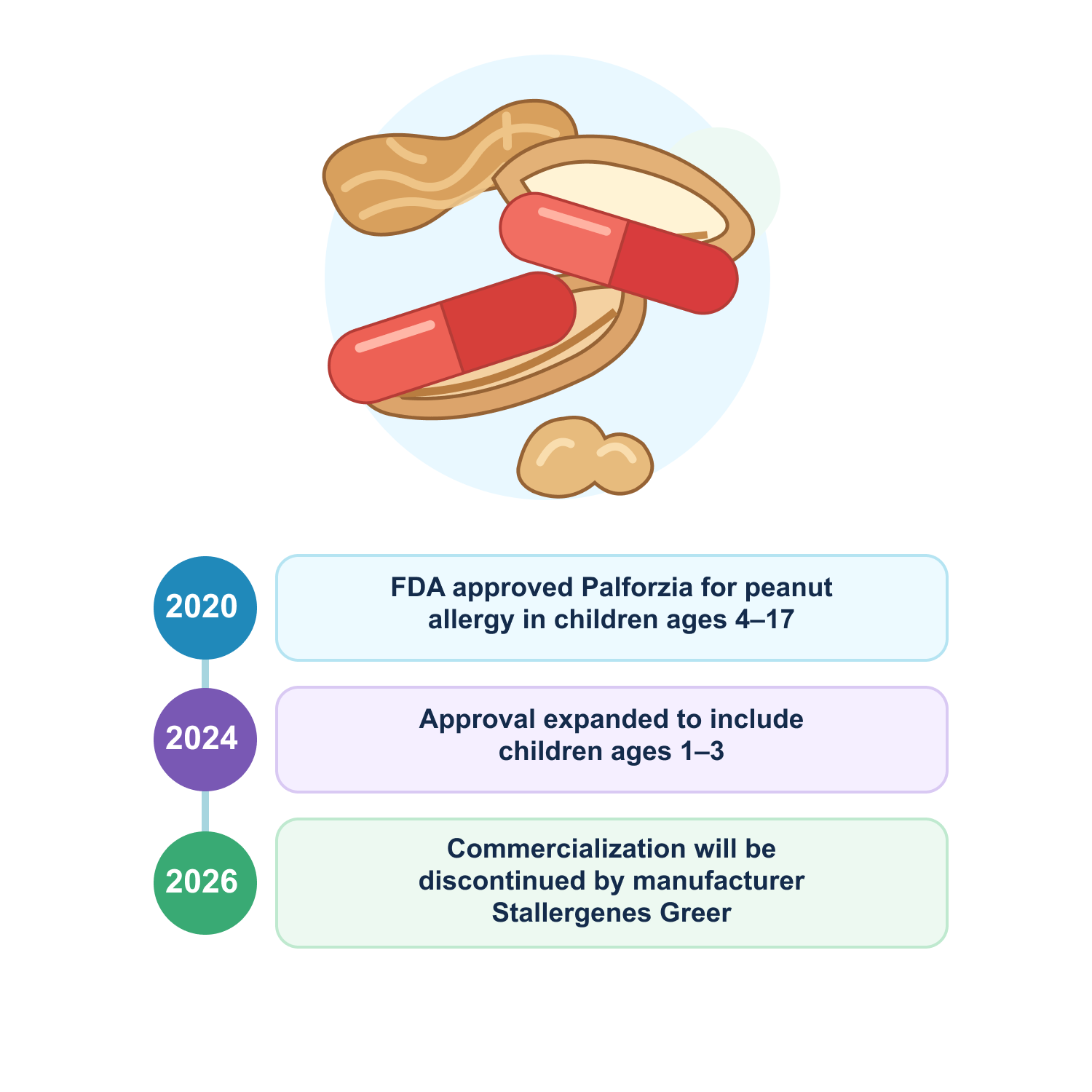
On 31 July 2026 the company that makes Palforzia, Stallergenes Greer, stopped production. The company said the decision was not about safety, quality, or how well the treatment worked. It was a business decision.
It does not mean OIT was unsafe
Palforzia's discontinuation does not mean peanut immunotherapy was unsafe. Alternatively, the safety, effectiveness, and access to oral immunotherapy with grocery-store foods led many allergists to prefer them over Palforzia®.
What this means if you were planning to start OIT
If you were on a waiting list, or had an appointment booked, talk to your allergist.
OIT still exists.
Allergists across the country offer peanut oral immunotherapy using their own protocols and their own measured peanut products.
The evidence still holds.
The trials that supported Palforzia® tested peanut protein given by mouth in gradually rising doses. Off-label oral immunotherapy follows very similar protocols.
The peanut is different.
The FDA-approval of Palforzia® covered the manufacturing and testing of the peanut powder itself, to ensure that doses were extremely consistent. Off-label immunotherapy with grocery-store peanut products will introduce some variability not tested in the Palforzia studies.
OIT may be easier to start than before.
Palforzia had a fixed protocol and a fixed top dose. Clinic-run programs may be more flexible based on a child's age, starting point, goals, and other factors.
What is actually different between Palforzia and off-label peanut OIT
Topic
PALFORZIA
OFF-LABEL OIT
What you take
Peanut flour in pre-measured capsules, emptied onto soft food.
Peanut flour, peanut butter, or a peanut product measured out by the clinic.
Dose Consistency
An FDA-approved manufacturing & testing process ensures that each capsule contains exactly the amount of protein claimed +/- 10%
No testing or guarantee on the change in peanut protein if using different forms of peanut, different peanut brands, or measuring using different spoons.
The allergen
Peanut protein with a specified amount of Ara h 1, Ara h 2, and Ara h 6, the major allergens in peanut
Peanut protein that may change based on the peanut, growing season, etc.
Dose schedule
One fixed schedule of 11 steps, the same for everyone.
Set by allergist. Often similar in shape, but adjustable.
Top daily dose
300 mg of peanut protein.
Usually between 300 mg and 3,000 mg, chosen by the clinic.
Who checked how it is made
The FDA reviewed the manufacturing and the amount of protein in each dose.
No one. Some clinics use standardized products; others measure out food themselves. No one tests the products to validate protein content.
Who checked whether it works
The FDA reviewed the trial results before approving it.
No FDA review of any individual clinic protocol. The general approach is well studied.
How exact the dose is
Each capsule holds a verified amount.
Depends on the product used and how carefully it is measured.
How it is paid for
Was a prescription drug, with possible insurance coverage including Medicaid.
Varies. Some office visits and supervision are billed to insurance. Out-of-pocket costs can be as high as $5,000 per year.
What you take
Palforzia
Peanut flour in pre-measured capsules, emptied onto soft food.
Off-label OIT
Peanut flour, peanut butter, or a peanut product measured out by the clinic.
Dose Consistency
Palforzia
An FDA-approved manufacturing & testing process ensures that each capsule contains exactly the amount of protein claimed +/- 10%
Off-label OIT
No testing or guarantee on the change in peanut protein if using different forms of peanut, different peanut brands, or measuring using different spoons.
The allergen
Palforzia
Peanut protein with a specified amount of Ara h 1, Ara h 2, and Ara h 6, the major allergens in peanut
Off-label OIT
Peanut protein that may change based on the peanut, growing season, etc.
Dose schedule
Palforzia
One fixed schedule of 11 steps, the same for everyone.
Off-label OIT
Set by allergist. Often similar in shape, but adjustable.
Top daily dose
Palforzia
300 mg of peanut protein.
Off-label OIT
Usually between 300 mg and 3,000 mg, chosen by the clinic.
Who checked how it is made
Palforzia
The FDA reviewed the manufacturing and the amount of protein in each dose.
Off-label OIT
No one. Some clinics use standardized products; others measure out food themselves. No one tests the products to validate protein content.
Who checked whether it works
Palforzia
The FDA reviewed the trial results before approving it.
Off-label OIT
No FDA review of any individual clinic protocol. The general approach is well studied.
How exact the dose is
Palforzia
Each capsule holds a verified amount.
Off-label OIT
Depends on the product used and how carefully it is measured.
How it is paid for
Palforzia
Was a prescription drug, with possible insurance coverage including Medicaid.
Off-label OIT
Varies. Some office visits and supervision are billed to insurance. Out-of-pocket costs can be as high as $5,000 per year.
What FDA approval changes
FDA approval signals verification of product manufacturing, design, and safety and efficacy when used in a specific way and for a specific reason. A lack of FDA approval does not mean a product or treatment is unsafe or that it doesn't work. Instead, talk to your doctor about what clinical data exists and what it demonstrates.
Checked manufacturing.
The FDA confirmed that each capsule held the amount of peanut protein the label claimed, made the same way every time. Your doctor may have suggestions on peanut form, brand, and measurement to increase consistency of doses.
Reviewed evidence.
An independent FDA panel examines the trial results. In the case of oral immunotherapy, there are many independently reviewed clinical trials of off-label treatment.
Standard protocol.
Every clinic using Palforzia® followed the same steps, so care did not depend on which clinic you went to. Some patients find that off-label OIT offers more flexibility that patients like.
What off-label OIT doesn’t change
Effectiveness.
Most published clinical studies of oral immunotherapy were performed using grocery-store foods. There is no evidence that Palforzia® produced better results than off-label OIT.
Safety.
Palforzia's own FDA-approved label carried a box warning about anaphylaxis and required that it be prescribed through a restricted safety program.
Alternatives to Palforzia
Office-based oral immunotherapy
Many allergists provide peanut oral immunotherapy using their own protocols and measured peanut products. This is the closest replacement for Palforzia® and the most direct path for those seeking oral immunotherapy. It is not FDA-approved, but the approach is well studied and widely used.
Oral immunotherapy asks more of a family day to day than most people expect. See what daily life on OIT looks like before you decide. You can also consider other options.
Sublingual immunotherapy (SLIT)
Sublingual immunotherapy means holding a small amount of peanut protein under the tongue each day. It causes fewer whole-body reactions than oral immunotherapy and takes less clinic time. It also builds less tolerance — people on sublingual immunotherapy generally reach protection against an exposure of one to three peanuts rather than a full serving. It is not FDA-approved and fewer allergists offer it.
Xolair (omalizumab)
Xolair is an injection given every two to four weeks. The FDA approved it in 2024 to reduce allergic reactions to foods in people aged one and older, and it remains approved. Xolair works by binding to the IgE antibodies that drive allergic reactions, which stops those antibodies from triggering a reaction. It does not retrain the immune system, so protection stops when the injections stop. Xolair can be used on its own or alongside immunotherapy.
Waiting
Choosing not to start treatment is a real option. Avoidance remains the standard of care, and deciding to wait does not close doors. Several treatments for peanut allergy are in clinical trials and may be approved in future. However, the evidence for immunotherapy treatment success is strongest for children aged 1-4. Talk to your allergist about how waiting may change your outcomes.
Questions to ask your allergist
Do you offer office-based oral immunotherapy, sublingual immunotherapy, or both?
What peanut product do you use, and how do you measure each dose?
How does your protocol compare with the Palforzia schedule?
What top dose do you aim for, and why?
What will this cost me, and how is it billed now that there is no approved drug?
Is my child a candidate for Xolair, on its own or alongside another treatment?
What are your rules about exercise, missed doses and illness?
KEEP READING