TREATMENT GUIDE
Sublingual immunotherapy (SLIT) for food allergy
A small dose under the tongue, daily
2 to 4 mg: about a hundredth of a peanut
Mostly at home, clinic visits every few weeks
Not FDA-approved, usually not covered by insurance
Reviewed by Hunter Smith, MD · Last reviewed October 2026

THE SHORT ANSWER
SLIT means holding a small, measured dose of a food protein under your tongue each day, then swallowing it. Over time, this can raise the amount of that food you can be exposed to before you react. Doses are tiny — usually 2 to 4 milligrams of protein, which is roughly a hundredth of a peanut. Most of it happens at home. After the first supervised dose, families dose daily on their own, with clinic visits every few weeks to increase the amount. It builds less tolerance than oral immunotherapy, while causing significantly fewer serious reactions. It is not FDA-approved. Allergists who offer it do so off-label, and it is usually not covered by insurance.
How it works
The tissue under your tongue is rich in immune cells that are particularly good at learning tolerance rather than triggering alarm. Delivering a very small amount of allergen there, every day, appears to gradually retrain the immune response to a food.
This is the same principle behind allergy drops for pollen and dust, which have been used for decades for environmental allergies. In this case, the target is a food rather than an airborne allergen.
SLIT DAILY DOSE
2 to 4 mg
of protein. SLIT stays at 2 to 4 milligrams.
OIT DAILY DOSE
Hundreds to thousands of mg
In oral immunotherapy, daily doses build up from one nut per day to as high as 20 per day.
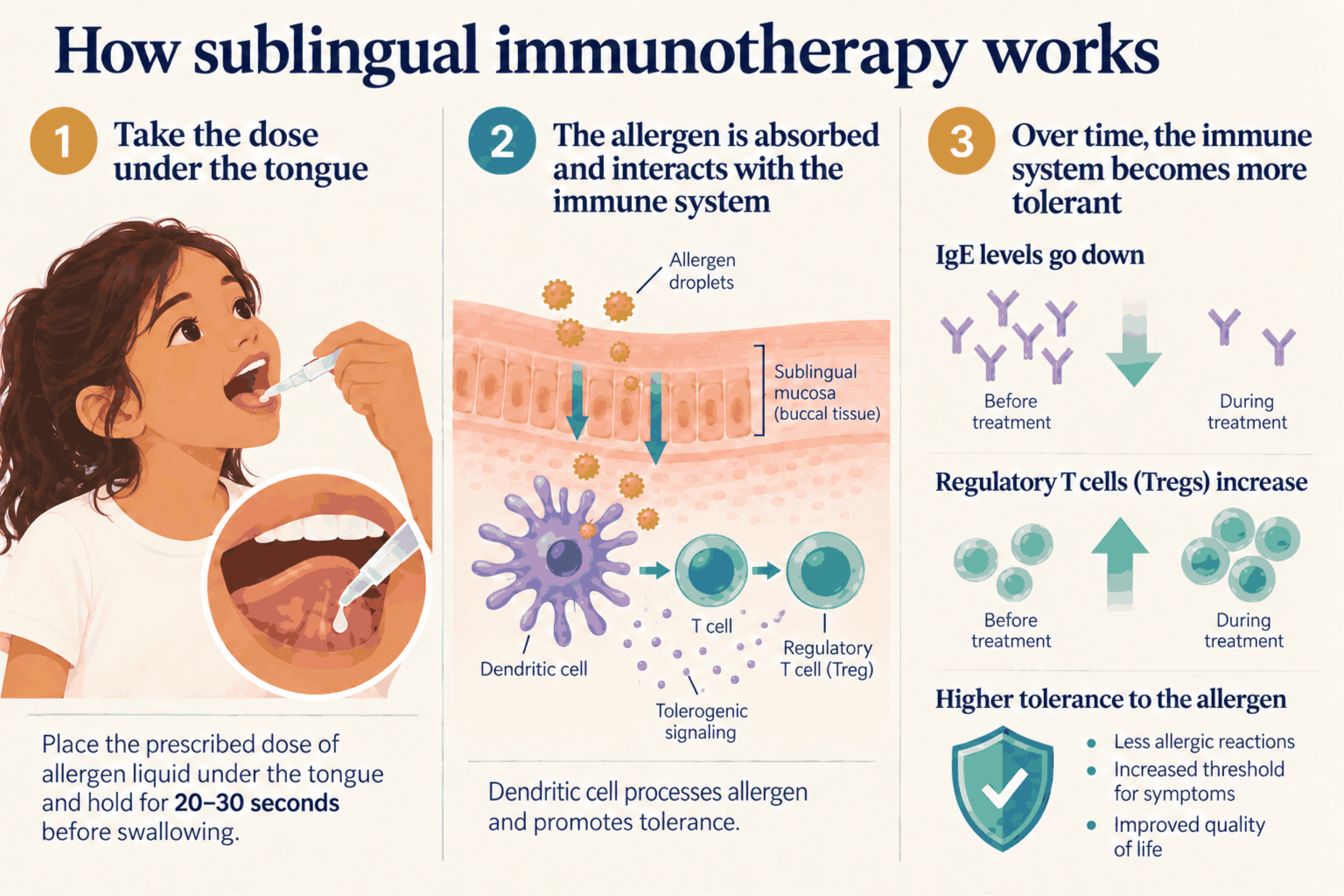
How sublingual immunotherapy works, step by step.
How sublingual immunotherapy works
1
Take the dose under the tongue

Place the prescribed dose of allergen liquid under the tongue and hold for 20 to 30 seconds before swallowing.
2
The allergen is absorbed and interacts with the immune system
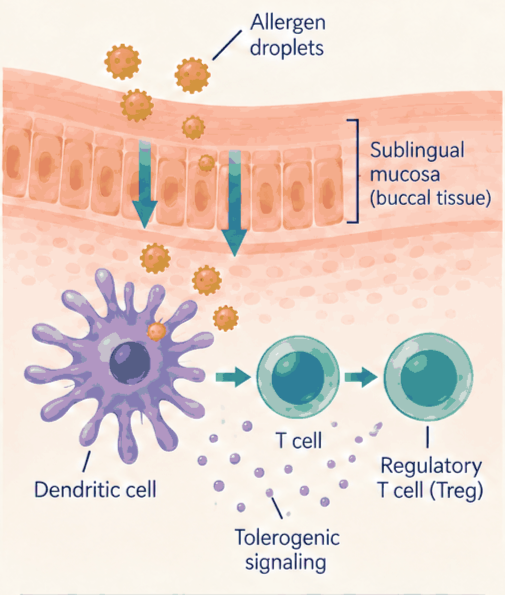
The dendritic cell processes the allergen and promotes tolerance.
3
Over time, the immune system becomes more tolerant
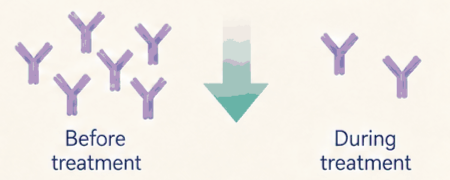
IgE levels go down
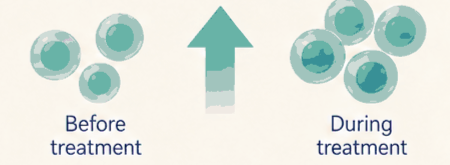
Regulatory T cells (Tregs) increase
Higher tolerance to the allergen

- Fewer allergic reactions
- Higher threshold for symptoms
- Better quality of life
What happens, step by step

01
A first appointment
Testing to confirm the allergy and establish a starting point, then a discussion of goals and potential side effects. Some practices do a food challenge first to measure your current threshold.

02
A supervised first dose
The first dose is given in the office and watched for a period afterward.

03
Daily dosing at home
The dose is held under the tongue for 20 to 30 seconds and then swallowed.

04
Increases approx. every month
In published protocols the dose is stepped up about every four weeks, over three to five steps, until the maintenance dose is reached.

05
Maintenance
The same dose every day. In studies, meaningful results took three to five years of daily dosing.

06
Checking progress
Some practices do a supervised food challenge after one to two years to measure what has changed.
What daily life on SLIT looks like
A TYPICAL CLINIC RECOMMENDATION
Exercise after a dose
No restriction
Hot bath or shower
No restriction
Watching after a dose
No restriction
Take with food
Never on an empty stomach; after at least a snack
Missed doses
Call allergist after more than 5 missed doses in a row if on maintenance or more than 2 missed doses in a row if on build up
Spacing between doses
Ideally around the same time every day
Day-to-day guidance
What to know about dosing, illness, and daily life on SLIT
Safe Dosing: hold for 20 to 30 sec
The liquid suspensions should be placed under the tongue and held in the mouth for 20 to 30 seconds before swallowing. Like hand washing, 15 seconds is about the length of time it takes to sing "happy birthday." If a patient has a strong cough and cannot hold the dose, it is best to skip dosing for the day.
Missed Doses: safe to resume after 1–2 days
Once on maintenance, SLIT is generally safe to resume after 1–2 days of missed doses. If a patient misses 4–5 doses in a row while on maintenance, they should consult their allergist before restarting. If a patient misses 2–3 doses while on build up, they should consult their allergist before restarting.
Restriction on Dosing: take with food
SLIT dosing with or after meals is always recommended to slow the body's absorption of allergens. Most patients require no rest period after dosing or significant restrictions against activity. Highly strenuous activities, like a high intensity workout, can still raise a person's risk of reaction. Normal play and most sporting or school activities including gym class do not need to be restricted.
Illness: pause if you have a fever
It is best to consult with a doctor before SLIT dosing if you are experiencing a fever. Dosing can generally continue with mild to moderate illness. If a fever causes you to miss more than 3 doses in a row, speak to your doctor before resuming.
Asthma Flare: withhold your dose and call your doctor
If you are experiencing an asthma flare, you should withhold your SLIT dose and consult with a doctor.
Storage: keep refrigerated
Liquid preparation of allergens for SLIT should be kept refrigerated as much as possible. Consult the bottle for specifics on shelf life.
Symptoms: mild mouth itching is expected
Mild itching or tingling in the mouth is to be expected. More severe symptoms such as stomach pain, trouble swallowing, and hives or rashes after dosing are rare and should be discussed with a physician.
Who tends to choose SLIT
The decision about which form or immunotherapy to pursue, or whether to pursue treatment at all is an individual decision.
Very young children have the best results.
In the randomized trial of one- to four-year-olds, 48 in 100 were still protected three months after stopping treatment. Results were strongest in one- and two-year-olds and declined with age.
Patients whose goal is protection from an accident, not eating the food.
This is what SLIT does best and it is what most of the research measures.
Children who have had a hard time with reactions.
SLIT causes far fewer whole-body reactions than oral immunotherapy — about 11 times fewer in one head-to-head study.
Families who cannot manage frequent clinic visits.
SLIT requires fewer, shorter, in-office visits, spaced farther apart.
People waiting for a place in an OIT program.
SLIT is something that can be started sooner because it requires less clinic oversight.
SLIT suits some people less well. If your goal is eating a full serving of the food, oral immunotherapy is more likely to get you there. If you are an adult, the pooled evidence does not show a clear benefit.

What the research shows
60 in 100
became desensitized in a randomized trial of very young children; 48 in 100 were still protected three months after stopping.
67 in 100
older children tolerated at least 750mg of peanut protein — about three peanuts — after three to five years of daily SLIT.
Worth knowing: most research is on peanut, with very little on milk, egg, or other foods. Studies on SLIT are also smaller than oral immunotherapy studies, making the evidence weaker overall.
For the full list of clinical studies, visit the evidence page.
Results vary by age
Safety
Most side effects from SLIT for food allergy are in the mouth and throat: itching, tingling, sometimes mild swelling of the lips. They usually start within seconds of a dose and settle on their own in a few minutes.
Most patients experience at least mild symptoms at some point during treatment. Across 75,366 doses taken in clinic and at home in the long-term peanut study, no one needed epinephrine. In a real-world group of 188 patients including higher-risk individuals, about 2 in 100 needed epinephrine at some point during treatment, and there were no life-threatening reactions.
Getting it
Food SLIT is offered by a small number of allergists in the United States. It is not FDA-approved, so allergists prescribe it off-label, and it is usually not covered by insurance. Some practices will treat patients across a wider area via telemedicine. If there is nobody nearby, it is worth asking whether a practice further away can work with you.
KEEP READING