TREATMENT GUIDE
Oral immunotherapy (OIT) for food allergy
The most effective treatment available
More reactions than avoiding the food
Regular 2-hour clinic visits in year one
Reviewed by Hunter Smith, MD · Last reviewed October 2026

IN SHORT
OIT means eating a small, carefully measured amount of a food every day, with the amount increased at clinic visits over time to a specific goal, followed by ongoing daily servings of that goal dose.
It is the most effective standalone food allergy treatment available. In pooled trials, people on peanut OIT were about 12 times more likely to pass a supervised food challenge than people avoiding the food.
OIT also causes more reactions than avoiding the food, including more anaphylaxis.
It needs regular 1-2 hour clinic visits in the first year, and may require lifestyle changes for safety around the daily dose.
Since Palforzia was discontinued in July 2026, there is no FDA-approved product for OIT, but many allergists offer OIT using their own protocols and grocery store foods.
How oral immunotherapy (OIT) works
Step up under supervision
You eat a measured amount of the food every day. Every few weeks, you return to the clinic, and the amount is increased under supervision, followed by an observation period in case of a reaction. Over months, the amount builds from milligrams to a target portion.
Then keep going
Once you reach the target amount, you keep eating it daily. For most people, protection depends on continuing daily servings indefinitely. For many people, stopping daily doses means losing protection.
Oral immunotherapy: example dosing schedule
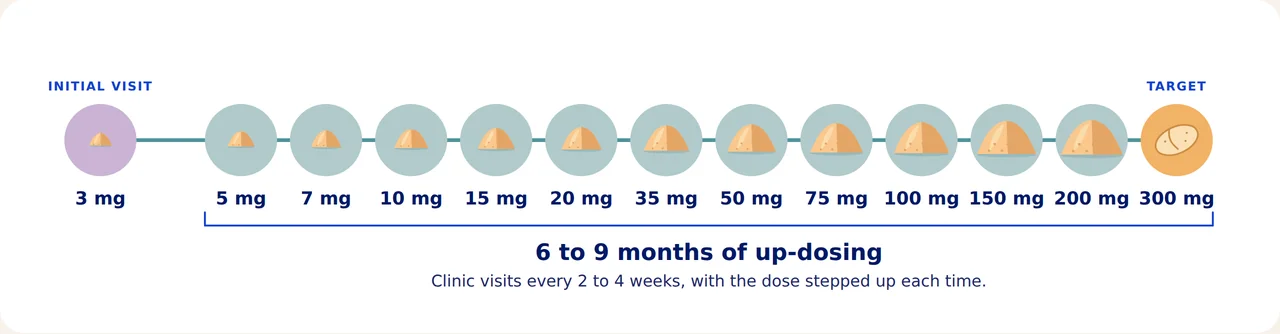
Illustrative schedule: doses and timing are individualized by the allergist. Food illustrations are not to scale.
Oral immunotherapy: example dosing schedule
3 mg
INITIAL VISIT
The first dose, 3 mg, is given at the clinic.
6 to 9 months of up-dosing
Clinic visits every 2 to 4 weeks, with the dose stepped up each time.
5 mg
7 mg
10 mg
15 mg
20 mg
35 mg
50 mg
75 mg
100 mg
150 mg
200 mg
300 mg
TARGET
300 mg of peanut protein, about one peanut.
Illustrative schedule: doses and timing are individualized by the allergist. Food illustrations are not to scale.
How well it works
12×
more likely to pass a food challenge
Pooled across 12 trials and about 1,000 people, peanut OIT made passing a supervised food challenge about 12 times more likely than avoidance or placebo.
40% vs 3%
passed a challenge
Roughly 4 in 10 people (40%) on OIT passed, compared with 3 in 100 (3%) without it.
3 in 5
Protection usually depends on continuing.
In one study, people took peanut OIT for 2 years and then stopped. Right before stopping OIT, about 85% could pass a peanut food challenge. Within 3 months of stopping OIT, about 3 of every 5 people lost that protection.
The evidence for OIT is very strong.
There are multiple randomized clinical trials, with thousands of participants, across many foods.
Most people who complete OIT can eat a full serving.
Many patients who go through OIT can achieve tolerance to a full serving of food, such as 15+ peanuts.
The risks, stated plainly
OIT works by giving you increasing amounts of a food you are allergic to. Because you are eating the food you react to, reactions can happen. Most are mild, like an itchy mouth, a few hives, or a stomachache. But reactions can also be serious.
~3×
Anaphylaxis is about 3 times more common during OIT than with avoidance.
Across pooled trials, about 22 in 100 people on OIT had anaphylaxis, compared with about 7 in 100 avoiding the food.
~2×
Epinephrine use is about twice as common.
About 8 in 100 people on OIT, compared with about 4 in 100 avoiding the food.
15 in 100
Stopped egg OIT because of side effects.
In one study, about 15 in 100 people stopped egg OIT treatment because of side effects. Vomiting and stomach symptoms are common and are one of the more frequent reasons families stop OIT.
Eosinophilic esophagitis has been reported.
Across five trials, EoE was reported in about 1-3% of patients undergoing OIT.
Reactions to doses may happen even at maintenance.
It is often said that most reactions to OIT happen in the early build-up phase and settle once you reach maintenance. A large analysis from 2019 found that reaction rates (mild or severe) were similar during build-up and during long-term maintenance.
Multiple foods at once
49 vs 12 in 100
Treating several foods together is harder than treating one. In a recent trial, everyone first got an anti-allergy injectable medicine called omalizumab. Then some people kept getting the shot, while others stopped the shot and started multi-food OIT. About 49 in 100 people on the multi-food OIT stopped before the end of the trial, mostly because of side effects, compared with about 12 in 100 who stayed on the injection alone. However, many patients successfully treat multiple foods at the same time.
Who it suits
People whose goal is protection from an accidental exposure by raising their threshold (the amount of the food it takes to set off a reaction). A higher threshold means it takes more of the food to cause a reaction, so a small accidental bite is less likely to make them sick. Some people also choose OIT because it may allow greater dietary flexibility in the future, although outcomes vary between individuals.
Families who can manage regular clinic visits with waiting periods, over many months.
People who can tolerate some reactions along the way because reactions are common. Most are mild, like an itchy mouth, stomach upset, or a rash. More serious reactions can happen but are less common.
It is less suitable where asthma is poorly controlled, where eosinophilic esophagitis is present, and it may be harder where several foods are involved.
KEEP READING